People behind Robots
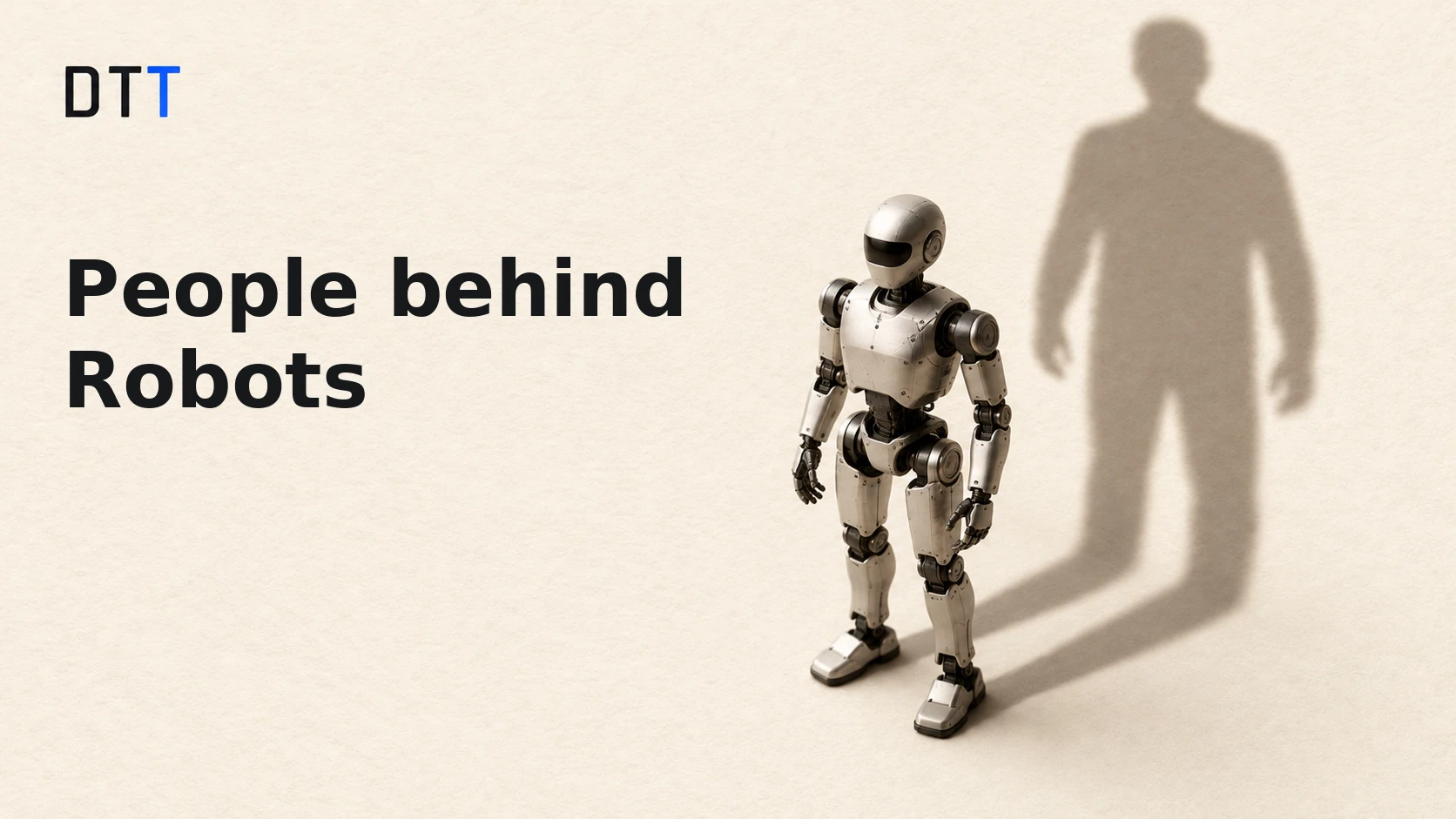
In today's explainer, I look at why robots can't learn housework the way ChatGPT learned to write, and why the robot industry now needs people.
Listen to this story
9 min 32 sec
The Story
Meet Mohamad Dunggio.
He's 23 and lives in Gorontalo, on the island of Sulawesi in Indonesia. In September, he told ABC News that he had strapped a phone to his head and recorded himself washing his dishes, over and over, for four hours.
That footage wasn't for Instagram. It was a lesson for a robot.
He told ABC that three companies, from Argentina, India and the US, had paid him between US$3 and US$10 an hour to film chores like washing dishes, cooking, ironing, folding clothes and sweeping. How does he feel about it? "I think it's OK because I exchange my time to earn money," he said.
This kind of recording has a name. Researchers call it egocentric data. It just means video shot from the worker's own point of view, so the camera sees what the hands are doing.
Now watch the video above. A humanoid robot moves through a home, doing chores. No complaints. No days off.
It's a company promo, so take it as a pitch. One day, a machine like this does the dishes so you don't have to.
So here's the question I want to answer today. How does a robot learn to wash a plate?
Think about how ChatGPT learned to write. Nobody sat down and wrote it lessons. Its makers trained it on huge collections of text that people had already written over decades: books, articles, websites, forum posts. Image tools learned the same way, from pictures that were already online.
The library already existed. The AI just had to read it.
Now, can we try the same trick with a robot?
There's no library of what your hands know. There are recipes of how to cook, but a recipe says "stir". It doesn't say how hard to grip the spoon, how fast to move it, or what to do when the bowl starts to slide. You've never written that down because you've never needed to. Your hands just know.
Videos don't fix this either. The internet has plenty of people washing dishes. But a video shows what happened. It doesn't record how hard the fingers pressed or how the plate felt when it got slippery. An ANI report on a Goldman Sachs expert call put it plainly: first-person video lacks information about physical forces and contact.
So how much data would a robot brain need? The same report estimated about 10 million hours of high-quality data that combines video with other signals from physical work. It's one estimate, from one expert call. But it gives you the scale. And there's no library of those hours to download and train.
Which means somebody has to make them.
To see who, it helps to split a robot into two parts.
The first is the body. Arms, hands, joints, motors, batteries, sensors. That's a hardware problem, and plenty of companies are working on it. UniX, the company in our video, is one of them.
The second is the brain. The software that looks at a messy kitchen and decides what to do next. That's the hard (software!) part. And a brain is only as good as what it learns from.
So the robot industry is being built in three steps.
Collect the lessons. Record real people doing real tasks, in enough detail that a machine can learn from it (you must've seen those garment factory workers wearing head-mounted cameras!)
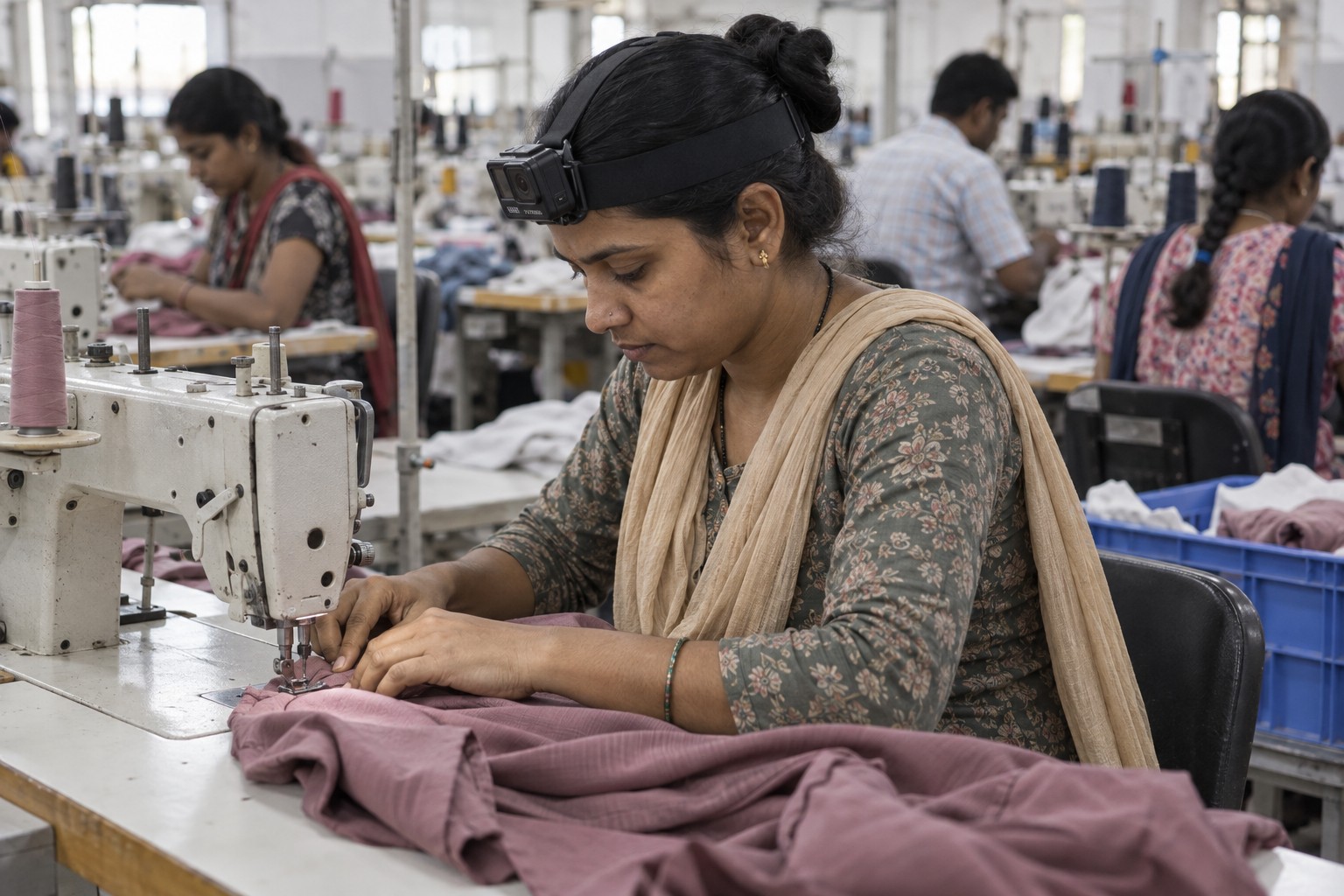
Train the brain. Use those lessons to build a model, the intelligence layer that turns what a robot sees into what its hands do.
Put the brain in a body. Only then does a robot start doing chores in your home.
Most of the headlines are about step three. A lot of the action right now is in steps one and two. And step one runs on people.
Appen, an Australian company that supplies training data for AI, told ABC it could collect around 60,000 hours of such video a month from as many as 5,000 people.
Some of the companies collecting it are brand new.
Take Human Archive. It was started by four students: Raj Patel, its CEO, Rushil Agarwal, Samay Maini and Shloke Patel. The company is in Y Combinator's Winter 2026 batch and has raised $8.2 million.
Its idea is that the robots need to learn from real work, so go where real work happens. Human Archive largely collects its data in India. In May, it told TechCrunch it had more than 1,000 active headsets out with workers, and was working with home-services, hotel and restaurant businesses. It paid workers a base rate of $1 an hour, according to that May report.
But Human Archive doesn't think a camera is enough. It believes video alone isn't sufficient, so it adds tactile gloves, a full-body motion suit and wrist cameras. In other words, it is trying to record not just what the hands did, but how hard they pressed.
Remember the plate getting slippery? That's the bit it is trying to capture.
Now you can see why India keeps coming up in this story.
India has a huge workforce that cleans, cooks and washes for a living, and a new wave of apps that send those workers into homes within minutes. For a robot company, that's an enormous classroom.
Human Archive went knocking. It asked Indian home-services companies, including Pronto and Urban Company, to work with it, and they turned it down.
But Pronto has been building its own version.
Pronto is the 10-minute house-help app, started in Gurugram in April 2025 by Anjali Sardana. It runs an opt-in service called Verified, where the worker wears a camera during the job. Pronto told Inc42 in November that faces are blurred, raw footage is deleted after the job, the customer can view a blurred copy for 48 hours, and anonymised footage is used for AI training.
In October, Sardana also set up Provision Labs in San Francisco, a company that collects data to train and test robot AI. In early November it bought Basilisk Industries, a Mumbai startup that had built a hand-tracking model and an early version of a glove that records touch. Then Moneycontrol reported on 24 November that there were plans to make Pronto a subsidiary of Provision.
What, if anything, passes between the two hasn't been made public. But prima facie it doesn't look like Provision will manufacture the robots when they have the robot training data goldmine.
Then comes step two, the brain.
Recordings of people help, but a human hand isn't a robot hand. So companies also make lessons with the robot itself. XDOF, a startup co-founded by two UC Berkeley researchers, has people steer pairs of robot arms by remote control and records every move. Its open dataset has more than 130,000 of these recordings across nearly 200 tasks. Others train robots in simulations, where a robot can fail a million times without breaking a single real plate.
All of that feeds the companies building robot brains. One of the best known is Physical Intelligence, which investors valued at $5.6 billion in November 2025. Its model, π0, starts from an AI that learned from internet images and text, the ChatGPT kind of learning. Then it is trained further on data from eight different robots, so it can output movements and not just words. The company shows it folding laundry and clearing tables.
That's the whole chain. People make the lessons. Models learn from them. Bodies carry them out.
Which brings us to the uncomfortable part.
What exactly is the worker being paid for?
When someone washes a plate for a customer, they get paid once, and the customer needs them again tomorrow. When they wash a plate for a camera, they still get paid once. But the lesson doesn't wear out. A model trained on it could, in theory, be copied onto thousands of robots.
And if it works well enough, the end product could one day compete for the same jobs. Seen that way, recording your chores starts to look like being paid to dig your own grave.
But that's not the only way to see it.
For now, the money is real and the robot isn't. Dana Kulić, a robotics professor at Monash University, told ABC that household robots are still a way off. "I feel like there's many problems to be solved beyond just the ability to do a specific task," she said. Economists also warn against assuming there's a fixed amount of work to go around. New machines have wiped out some jobs and created others before.
And Dunggio himself calls it a fair trade of his time for money.
The harder questions are about the deal itself. Does the worker know what the recording is for? Can they say no and still get ordinary work? Who owns the lesson once it's made? And what about the family whose kitchen is in the frame?
India's IT ministry is asking some of these too. On 12 November, it called Pronto, Urban Company, Snabbit and some robotics firms to a meeting, to ask whether footage is sold, to whom, how long it's kept, how customers and workers agree to it and how workers are paid for it.
So, how does a robot learn to wash a plate?
The same way you did. By watching someone do it, again and again, until the movements make sense. The difference is that the robot needs millions of hours of it, recorded in detail, and somebody has to be paid to stand at the sink.
The robot in the video is the last step of a long chain. The first step is a person with a camera on their head.
Whether that person is training a helper or a replacement? We don't know!
Edited by Parag Somani
Sources
UniX AI, Household and Hotel page and promo video (company material, not an independent test): https://www.unix-group.ai/Household-Hotel
ANI via The Tribune, 30 Oct 2026, Goldman Sachs expert call on 10 million hours and missing force data: https://www.tribuneindia.com/news/business/ai-robotics-may-need-10-million-hours-of-interaction-data-to-reach-production-level-capabilities-goldman-sachs/
ABC News, 20 Sep 2026, Mohamad Dunggio's account and pay, Appen's capacity, Dana Kulić: https://www.abc.net.au/news/2026-09-20/egocentric-training-gig-workers-helping-robots-learn-tasks/107135216
TechCrunch, 26 May 2026, Human Archive's founders, funding, headsets, $1 base rate, sensors, Pronto and Urban Company declining: https://techcrunch.com/2026/05/26/human-archive-taps-into-indias-services-startups-to-collect-data-for-physical-ai/
Y Combinator, Human Archive company page (founders, Winter 2026 batch): https://www.ycombinator.com/companies/human-archive
Business Today, 6 Oct 2026, Pronto's founding: https://www.businesstoday.in/india/story/prontos-rapid-rise-how-a-23-year-old-anjali-sardana-turned-an-idea-into-a-rs2000-crore-home-help-startup-559610-2026-10-06
Inc42, 8 Nov 2026, Pronto's Verified service and how footage is handled: https://inc42.com/features/prontos-second-shift/
Inc42, Oct 2026, Provision Labs set up in the US: https://inc42.com/buzz/pronto-founder-anjali-sardana-sets-up-physical-ai-venture-provision-labs-in-us/
Inc42, Nov 2026, Provision acquires Basilisk Industries: https://inc42.com/buzz/pronto-founders-provision-labs-acquires-hardware-startup-basilisk-industries/
Moneycontrol, 24 Nov 2026, reported plan for Pronto to become a Provision subsidiary, and Sardana's response: https://www.moneycontrol.com/news/business/startup/pronto-to-become-provision-labs-subsidiary-as-anjali-sardana-pivots-to-physical-ai-eyes-50-million-fundraise-14087550.html
TechCrunch, 4 Sep 2026, XDOF's founders and what it does: https://techcrunch.com/2026/09/04/xdof-just-three-months-out-of-stealth-is-in-talks-for-a-series-b-at-a-1-2b-valuation/
XDOF, ABC-130K open teleoperation dataset: https://www.xdof.ai/blog/abc-130k
Bloomberg, 20 Nov 2025, Physical Intelligence valued at $5.6 billion: https://www.bloomberg.com/news/articles/2025-11-20/robotics-startup-physical-intelligence-valued-at-5-6-billion-in-new-funding
Physical Intelligence, π0 model post: https://www.pi.website/blog/pi0
MediaNama, 13 Nov 2026, the IT ministry's meeting on footage: https://www.medianama.com/2026/11/223-footage-train-robots-meity-questions-platforms/