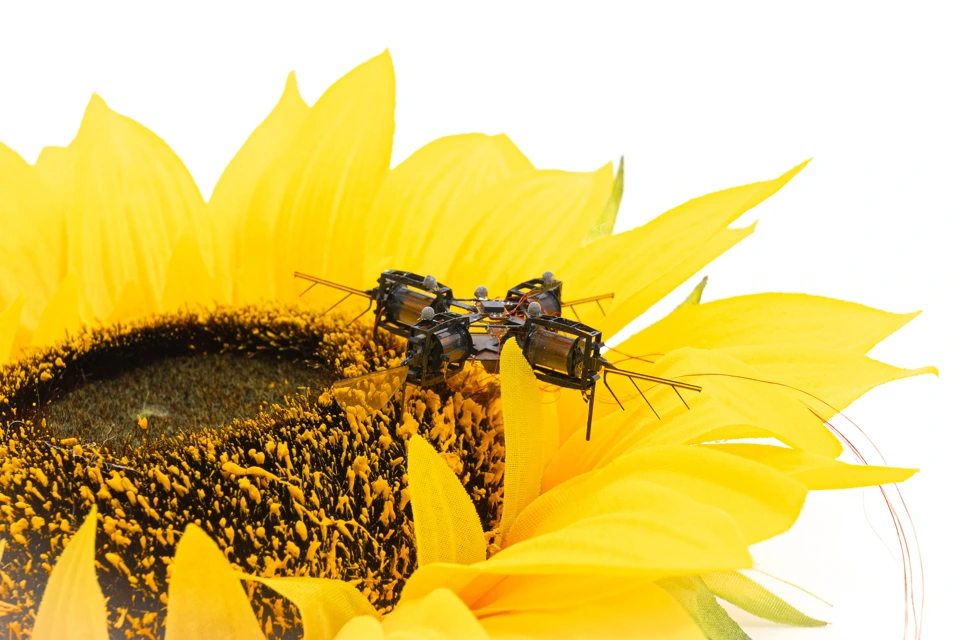
MIT's 1.29-gram flying robot carries its own sensors and computer
Photo: Courtesy of the researchers / MIT News. Research demonstration; external power tether required. CC BY-NC-ND 3.0A flying robot lighter than a paperclip has moved beyond the motion-tracking cameras normally used to keep insect-scale robots stable in a laboratory. Researchers at MIT and Cornell have demonstrated a 1.29-gram flapping-wing robot that carries the sensors and computing needed to hover, follow a path and land on a sunflower.
The advance is in sensing and flight control, not a self-powered robot ready for fields. The robot still draws electricity through a tether, and a human operator supplies high-level movement commands. In a 30-second experiment outside a motion-capture environment, it avoided obstacles and landed on the flower. The paper, published in Science Robotics on November 18, reports centimetre-scale positional accuracy.
Getting the electronics aboard meant changing the machinery that keeps the robot aloft. Its wings are driven by soft actuators, artificial muscles that expand and contract. The researchers adjusted their radius and length, increasing actuator size by 50 percent while raising net lift force by 46 percent. A lift-to-weight ratio of 1.9 gave the robot room to carry a 244-milligram electronics package.
That package combines sensors that track orientation, sideways movement and height with a microcontroller that estimates the robot's state and controls its flight. The team found that a faster, simpler position estimate worked better than a slower, more accurate calculation. Mounting the electronics on a fibreglass support helped them withstand the robot's vibrations.
The result addresses a real obstacle to small flying robots: they cannot carry the navigation equipment used by larger drones, yet external tracking cameras limit where they can operate. Bringing sensing and computation onto the robot is a step towards working outside that controlled setup. Onboard planning and an independent power supply remain further engineering goals.
The researchers describe possible future uses in precision agriculture and inspection, where a small robot could approach delicate plants or confined spaces. The sunflower landing is a demonstration of controlled flight, not evidence of commercial pollination or autonomous agricultural work. The immediate result is a lighter navigation and control system that can fly with the robot itself.
Based on MIT News and the Science Robotics paper abstract, 18 November 2026. This is a research demonstration with external power and human high-level commands, not a fully autonomous or commercial pollination system. Photo supplied for press use by MIT News, credited to the researchers.
Additional reporting
A 1.29-gram flapping-wing robot hovers and tracks trajectories with onboard sensing and computation.
30-second flight outside motion capture, with human high-level commands, obstacle avoidance and a sunflower landing.
244 milligrams of sensors and computing; centimetre-scale positional flight accuracy reported.
Still tethered to an external power supply. Onboard planning and independent power remain future work.