Sarvam opens India-hosted inference service for its own and other AI models
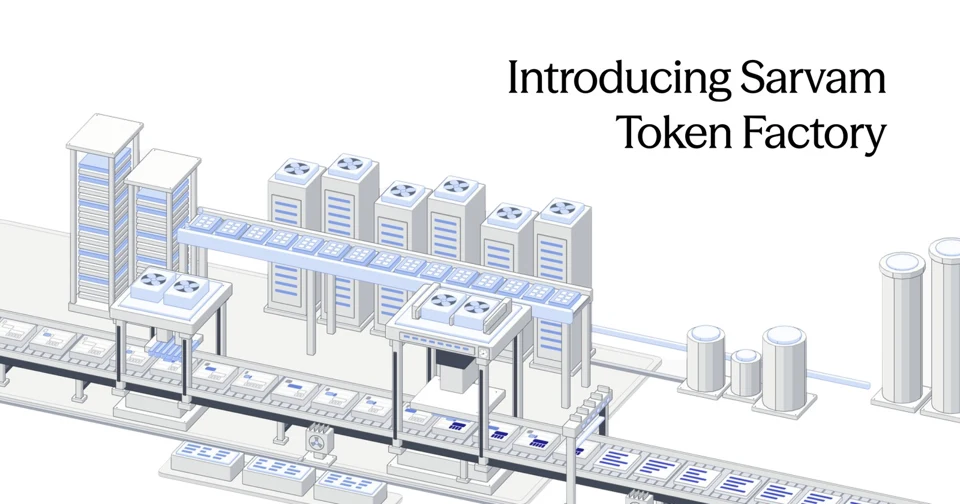
Official Token Factory illustration: Sarvam AI. This is artwork, not a photograph of a physical factory.Sarvam AI announced public availability of Token Factory on November 16, a service that runs AI models on graphics processors in India. Developers send it a request and receive a model's answer through an application programming interface, or API, rather than buying and managing the hardware themselves. The service offers Sarvam's own models alongside open-weight models from other developers. Open-weight means the model's trained numerical settings are available under its licence; it does not mean unrestricted use.
This is an inference service: it runs a trained model to produce an answer, rather than training a new model from scratch. Sarvam lists models from the GLM, DeepSeek, Kimi and Gemma families alongside Sarvam 105B. Its API follows the OpenAI format, which can reduce the changes needed in applications already built around that interface. Model availability and licence terms still need to be checked for each use.
The company's technical work is in serving those models efficiently. Its launch material describes optimised software kernels, the routines that carry out calculations on the hardware, plus small draft models that help predict output faster, and separate computing stages for processing a request and generating its answer. It also describes routing requests to make better use of previously processed text, reducing repeated computation.
Sarvam reports a 0.2-second time to the first output token for its 105-billion-parameter model and a single-user generation rate of 330 tokens per second. Tokens are the fragments of text a model reads and writes. These are company-reported results under its test conditions, not independent DTT measurements or a promise that every application will see those speeds. Its comparisons use specific models, hardware, request lengths and numbers of simultaneous users.
For Indian developers, the practical addition is another way to access several models through one India-hosted service. Sarvam also says it can run its inference stack on an organisation's own premises. Hosting location alone does not establish every aspect of data handling, and teams still need to check the service's terms, model quality and performance on their own workloads.
Sarvam's native launch post is dated November 16, while the linked technical blog displays November 7. This story reports the November 16 public-availability announcement and preserves that date difference. It is separate from Sarvam's earlier Prism model release, which DTT has already covered.
DTT summary of the November 16 public-availability announcement. The official technical blog displays November 7. Performance and cost comparisons are Sarvam claims, not independent DTT test results.
Additional reporting
Runs trained AI models to answer requests through one API. It is not a newly announced AI chip or a model-training factory.
Sarvam says its own and other open-weight models run on GPU clusters in India; on-premise deployment is also offered.
Numbers are vendor-reported under specific test conditions. DTT has not independently benchmarked the service.
Native public-availability announcement: 16 November. The technical blog displays 7 November.