TDK and Microchip demonstrate networked sensor boards for robots
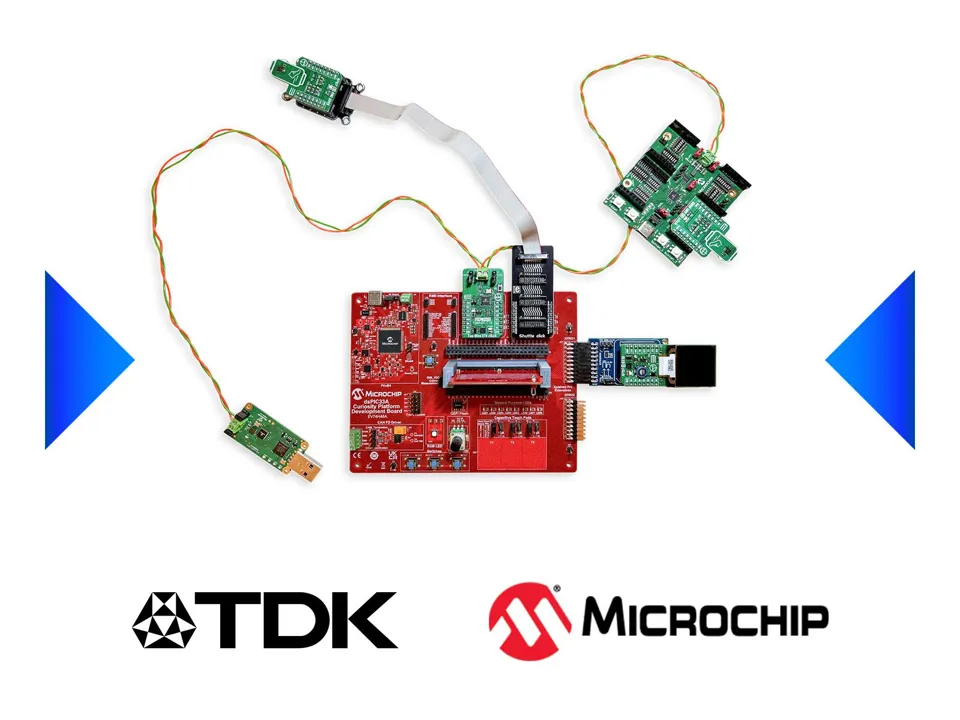
Connected sensor demonstration boards with TDK and Microchip branding. Photo: TDK InvenSense.TDK and Microchip are demonstrating a distributed sensor-node platform for robots at electronica in Munich. Their November 10 announcement combines TDK InvenSense motion sensing with a Microchip digital signal controller and single-pair Ethernet networking. It is a demonstrated integration board, not a claim that a new autonomous robot has entered service.
A sensor node is a small local unit that measures something and processes the reading before sharing it. Robots may need many such measurements, including joint movement, vibration and orientation. Sending every raw reading to one central computer adds wiring and processing work. The demonstration processes and combines readings near the sensor, then sends relevant information over a shared network.
The board includes Microchip's dsPIC33A controller, LAN8651/LAN8679-based 10BASE-T1S connectivity and TDK's ICM-42688-P inertial measurement unit. The controller is a chip designed for fast numerical processing and control. The motion sensor combines a three-axis accelerometer, which measures acceleration, with a three-axis gyroscope, which measures rotation. Together they help estimate how a part of a robot is moving.
10BASE-T1S is an Ethernet standard that lets several devices communicate over one pair of wires. That can simplify a robot's cabling compared with giving every sensor a separate connection to the main controller. The demonstration also has an expansion connector for compatible additional sensors. The partners describe local sensor fusion, filtering, diagnostics and machine-learning functions, including gesture recognition.
The controller has a 200-megahertz, 32-bit core, digital signal-processing acceleration and floating-point hardware. These are component capabilities, not measured end-to-end robot performance. The announcement does not publish a latency comparison, a power reduction, a maximum tested node count or a named production robot using the platform.
The building blocks for the board are already available, according to TDK. The new development is their integration into a reusable sensor-network demonstration. Lower traffic, simpler wiring and faster local responses are intended benefits, rather than quantified gains established by a published benchmark.
DTT summary based on TDK InvenSense's report. The full article is on the publisher's site.
Additional reporting
Distributed sensor-node board shown at electronica, Munich.
dsPIC33A controller, ICM-42688-P motion sensor and LAN8651/LAN8679-based networking.
No published end-to-end latency, power or tested node-count benchmark.