Boston Dynamics puts wheels on Atlas to test robot control
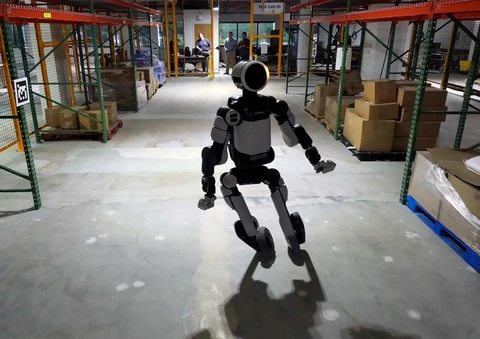
Atlas using wheels in a controls research experiment. Photo: Boston Dynamics.Boston Dynamics has fitted wheels to its Atlas humanoid robot for a research experiment on motor control and whole-body learning. The company described the work on November 9, 2026. A wheeled Atlas is a research testbed, not a new commercial product, according to the company.
The experiment replaces Atlas’ feet with scooter wheels. A custom adapter connects each wheel rim to the robot’s existing ankle actuator, the motor-and-drive mechanism that normally moves its ankle. In the control software, each wheel is treated as an ankle that can rotate continuously. The aim is to push the motors through demanding combinations of speed, turning and load.
The team combined low-level motor control with whole-body reinforcement learning. Reinforcement learning trains a controller through repeated attempts in simulation, using feedback to improve its behaviour. The learned controller then tells the real robot how to coordinate its body. For this to work well, the simulated motors need to behave much like the motors on the real machine.
Controls engineer Xiaoyu (Andy) Wu describes checking control settings, measuring the actuators and tuning their simulated models. Some movements used human motion-capture recordings as reference trajectories. In the demonstrated side-dash movement, the controller used the wheels to roll rather than slide its feet. The company also shows a jumping turn based on a human motion recording.
The engineering lesson is about the transfer from simulation to hardware. A controller can learn shortcuts that do not work on a real robot if its simulated motors are too idealised. Testing demanding movements helps the team find and reduce that gap. The next research direction includes how a controller responds when actuators fail; that work should not be read as an already-proven fault-tolerance capability.
The results are being adapted to the standard Atlas configuration, Boston Dynamics says. The post does not announce a customer deployment, a price or availability for a wheeled Atlas. It also does not establish that one successful demonstration makes the robot reliable across every warehouse or factory task.
DTT summary based on Boston Dynamics's report. The full article is on the publisher's site.
Additional reporting
Scooter wheels attached to existing ankle actuators with a custom adapter.
Test motor behaviour and whole-body learning under demanding motion.
Controller trained in simulation, with motor models tuned to measured hardware behaviour.
Research testbed, not a commercial wheeled Atlas launch.
Investigate responses to failed actuators; not a completed reliability guarantee.