Karnataka's chip and robotics infrastructure plans: what the Rs 390 crore backs
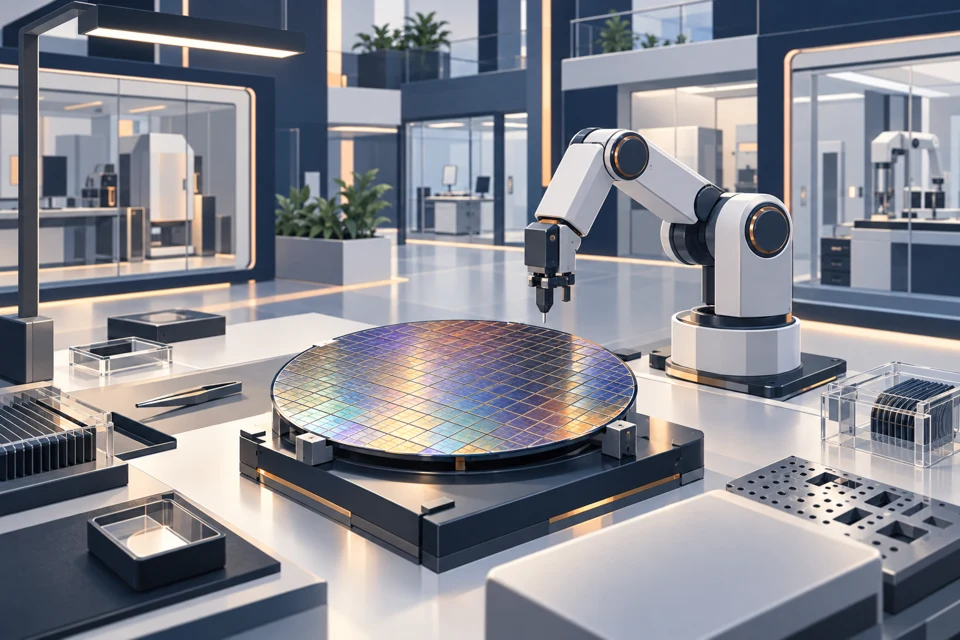
AI-generated editorial illustration by DeepTechTracker. Not an image of INFIfab, the 2D Hub or BRAINZ.Karnataka's semiconductor and robotics plans at Bengaluru Tech Summit centre on a practical problem: researchers and startups need expensive equipment, shared laboratories and space to turn prototypes into usable technology. A funding breakdown reported by The Hindu BusinessLine puts the state's own commitments at Rs 390 crore across three projects at or linked to the Indian Institute of Science: INFIfab, the 2D Innovation Hub and BRAINZ.
The three figures cover different kinds of infrastructure. BusinessLine reports Rs 40 crore from the state towards INFIfab, against a proposed project investment of Rs 1,025 crore; Rs 250 crore towards the 2D Innovation Hub's Rs 704.57 crore outlay; and Rs 100 crore plus about nine acres for BRAINZ. These are reported commitments, not a statement that all project spending has already taken place.
INFIfab is a planned microfabrication translation and prototyping centre associated with IISc's Centre for Nano Science and Engineering. Its project site describes facilities for advanced packaging, MEMS, photonics, quantum technologies and other device research. The aim is to give researchers and companies access to processes and equipment needed to move from a laboratory result to a prototype that can be tested and developed further.
The 2D Innovation Hub is a separate national 200-mm, or eight-inch, research fab and technology-translation platform. IISc's September 2026 expression of interest describes wafer-scale materials growth, device processing, metrology, reliability testing and shared access, initially focused on two-dimensional materials for next-generation semiconductors. Two-dimensional materials are extremely thin layers whose electrical and other properties can be used to explore new device designs.
That September document names ANRF, the Ministry of Electronics and Information Technology, Karnataka and industry partners as funders. Shared equipment and specialist support are intended to help researchers develop materials, fabricate devices and test whether prototypes can be reproduced reliably.
BRAINZ, the Bengaluru Robotics and AI Innovation Zone being developed by ARTPARK with IISc, is a campus project for robotics, AI and related engineering work. ARTPARK describes prototyping and experimentation laboratories, research and skilling spaces, and areas where startups, researchers and companies can work together. BusinessLine reports an expectation of more than Rs 1,000 crore in follow-on investment over five years. That expectation is separate from the Rs 100 crore state commitment.
The summit brings these projects into one policy picture. The 2D Hub was already seeking cleanroom and project-management expertise in September, ARTPARK had described BRAINZ before the summit, and CeNSE identifies INFIfab as an upcoming plan. The reported state backing supports these ongoing efforts to expand research and prototyping infrastructure.
For hardware startups, the value will depend on how shared access works in practice: which tools become available, what support teams provide, and how quickly researchers can move through fabrication, testing and iteration. The projects address different parts of that journey, from making experimental devices to testing physical systems and developing them with industry.
State commitments and project amounts: The Hindu BusinessLine, 17 November 2026. Project scope and development status: IISc, CeNSE, INFIfab and ARTPARK. Earlier project work predates BTS. Illustration is AI-generated and does not depict an actual facility.
Additional reporting
Rs 390 crore across three projects: INFIfab Rs 40 crore, 2D Innovation Hub Rs 250 crore and BRAINZ Rs 100 crore.
Planned microfabrication translation and prototyping centre; proposed project investment Rs 1,025 crore.
National 200-mm R&D fab and technology-translation platform; Rs 704.57 crore outlay. IISc published an EOI in September 2026.
ARTPARK-IISc robotics and AI campus project, about nine acres. More than Rs 1,000 crore follow-on investment is expected over five years, separate from state backing.
IISc names ANRF, MeitY, Karnataka and industry partners in its September 2026 EOI.