Xanadu and HyperLight report lower light loss in quantum switches
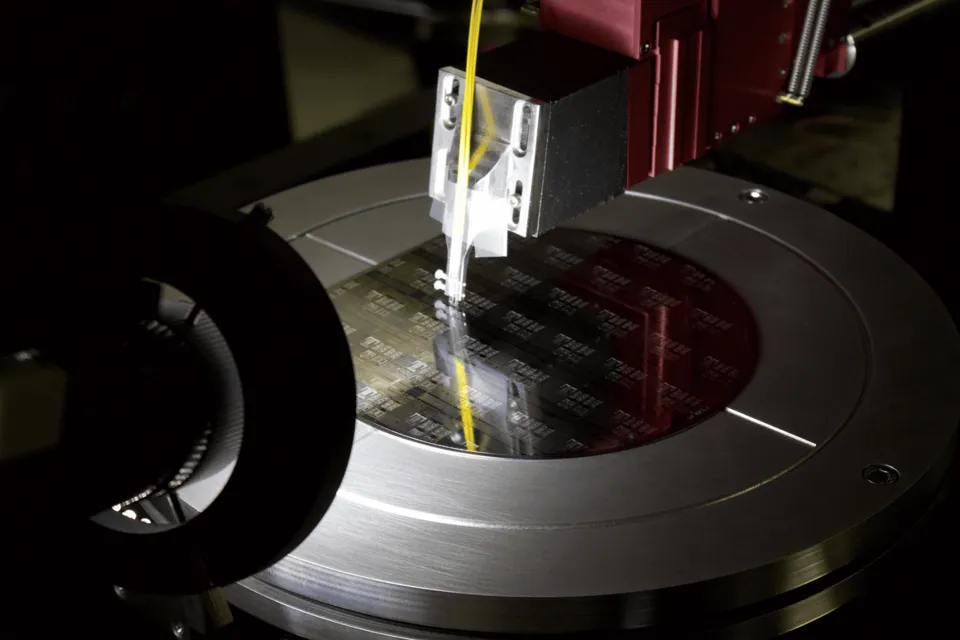
A patterned thin-film lithium niobate wafer undergoing optical testing. Photo: Xanadu.Xanadu and HyperLight report reducing the insertion loss of an optical switch to 7 millidecibels, compared with their 20-millidecibel benchmark announced in 2025. The November 10 announcement describes a component-level result on HyperLight's thin-film lithium niobate manufacturing platform, rather than a completed quantum computer.
Photonic quantum computers use particles of light, called photons, to carry quantum information. An optical switch sends those photons along different routes. Insertion loss measures how much light is lost when it passes through that component. A millidecibel is one-thousandth of a decibel, a logarithmic unit for measuring signal changes; a smaller loss means more of the incoming light survives.
Reducing loss matters because quantum information cannot be copied and amplified like an ordinary electrical signal. Losing photons can force a system to use more hardware and error-correction resources. The reduction from 20 to 7 millidecibels is nearly threefold in the quoted loss figure. It is not a threefold increase in computer speed, nor evidence that a complete fault-tolerant quantum computer is ready.
Thin-film lithium niobate is a light-controlling material deposited as a thin layer on a chip. Its optical properties change in response to an electric field, allowing a switch to route light electrically. The companies say they demonstrated the new result using a high-volume wafer manufacturing line and describe good yield and repeatability.
The release does not provide a numerical yield distribution, sample count, measurement uncertainty, switching speed, operating wavelength or extinction ratio, which describes how completely a switch blocks the unwanted route. Converge Digest also notes that no paper or preprint accompanies the announcement. Those gaps limit independent comparison and make the result a company-reported benchmark, not a fully documented system-level validation.
Xanadu says the switches are ready to ramp toward production and expects the lower loss to improve manufacturing economics and reduce system size. The announcement does not give production volumes, a ramp date or a first commercial system using the new switches. Those benefits remain expectations separate from the reported component measurement.
DTT summary based on Xanadu's report. The full article is on the publisher's site.
Additional reporting
7 millidecibels optical switch insertion loss, versus the partners' 20-millidecibel benchmark in 2025.
Thin-film lithium niobate optical switches on HyperLight's photonics platform.
Company-reported component benchmark; no paper, sample count or numerical yield distribution disclosed.