SE3 raises $30 million to help drones understand their surroundings
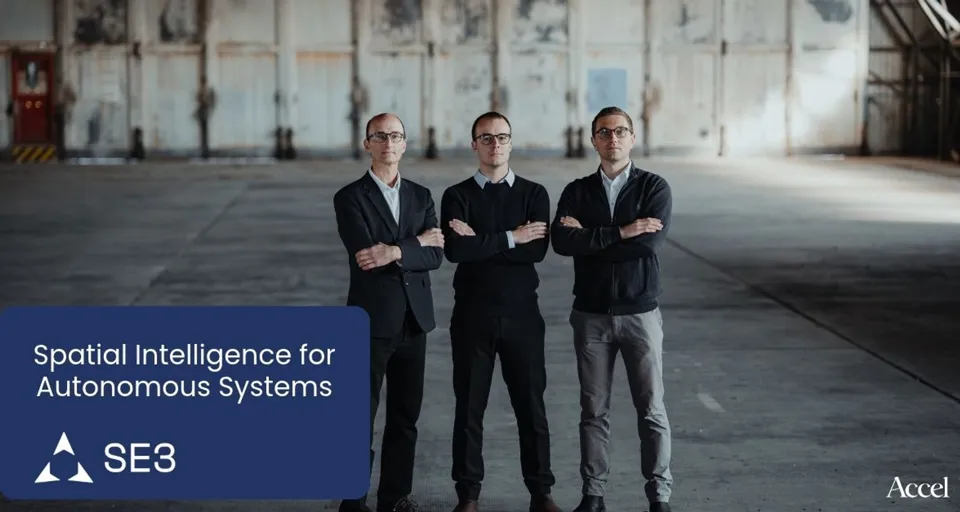
Photo: Accel, official SE3 investment announcement. The SE3 founding team, shown in the source artwork.Left to right: Daniel Cremers (Co-founder and Chief Science Officer, SE3); Lukas Köstler (Co-founder and CEO, SE3); Simon Klenk (Co-founder and CTO, SE3).SE3 has raised $30 million in Series A financing led by Accel, with participation from Keen Venture Partners and continued backing from Lakestar and Seedcamp. The Munich company and its investors announced the round on November 12. It builds software for drones and other autonomous machines rather than manufacturing a competing drone platform.
Its focus is spatial intelligence: helping a machine understand where it is, what surrounds it and how it can move. Computer vision, which interprets images from cameras, is combined with other sensor data to create a shared three-dimensional picture of an environment. The software is intended to work across equipment from different manufacturers.
That matters when satellite navigation is disrupted or conditions change quickly. The software can run at the edge, meaning on equipment near the sensors rather than relying entirely on a distant cloud computer. CEO Lukas Köstler told Fortune that basic navigation without GPS has been delivered thousands of times, but higher-level fleet command by voice is less mature and needs one or two more years of work. Actions such as takeoff can be set to require human approval.
Accel says SE3 is working on contracts with Ukraine and Germany’s armed forces, and is an AI partner to HENSOLDT, Auterion and ERC System. Keen says the software is deployed in Ukraine and has shipped on thousands of systems. Those deployment figures are investor-reported; the funding release does not provide an independent reliability benchmark.
The company was founded by CEO Lukas Köstler, CTO Simon Klenk and chief science officer Professor Daniel Cremers. It spun out of Cremers’ computer-vision lab at the Technical University of Munich, where Köstler and Klenk were pursuing doctorates. The team’s immediate commercial focus is European defence, with civilian robotics a longer-term direction.
Independent reporting says the capital will expand engineering, commercial and operations teams and support a wider European presence, including the United Kingdom. The $30 million is a new Series A, separate from the €5.5 million seed financing announced earlier in 2026. No valuation was disclosed in the announcements reviewed.
DTT summary based on Accel's report. The full article is on the publisher's site.
Additional reporting
$30 million Series A, announced November 12, 2026. New $30 million Series A, separate from the earlier €5.5 million seed round. No valuation disclosed in the reviewed announcements.
Builds software that combines camera and sensor data into a shared three-dimensional view for drones and other autonomous machines.
The software combines camera and sensor feeds into a shared 3D picture and runs near the equipment rather than relying entirely on the cloud.
Basic navigation without GPS has shipped; higher-level fleet command by voice is less mature and still being developed, according to the CEO.
Engineering, commercial and operations hiring and expansion of its European presence, including the United Kingdom.