Diodes releases isolated current sensors for EV charging systems
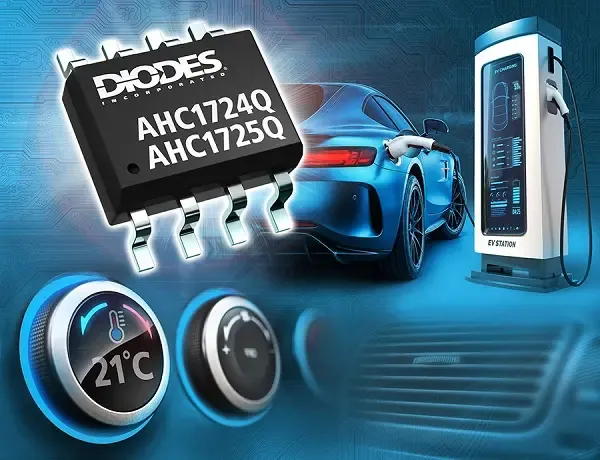
AHC1724Q and AHC1725Q current-sensor product illustration. Image: Diodes Incorporated, via Semiconductor For You.Diodes Incorporated has released the AHC1724Q and AHC1725Q automotive current sensors for applications such as onboard electric-vehicle chargers and charging stations. The November 10 launch introduces compact devices that measure alternating or direct current while electrically separating the measured power path from the sensor's output connections.
The devices use the Hall effect: current flowing through a copper conductor creates a magnetic field, and a nearby sensing circuit converts that field into a proportional voltage. That lets a control system estimate how much current is flowing. Galvanic isolation means there is no direct electrical connection between the high-current conductor and the sensor's signal leads, helping the measurement circuit operate separately from the power circuit.
Both parts have a typical conductor resistance of 1.2 milliohms, a current-measurement range reaching plus or minus 50 amperes, and a 120-kilohertz analogue output bandwidth. Lower conductor resistance reduces the heat created as current passes through the sensor. The company lists a typical response time of 4 microseconds and propagation delay of 2 microseconds; those describe different timing characteristics and are not the same specification.
The AHC1724Q uses a 4.5-to-5.5-volt supply and offers ranges from plus or minus 2.5 amperes to plus or minus 50 amperes. The AHC1725Q uses a 3.0-to-3.6-volt supply and starts at plus or minus 5 amperes. Both come in an eight-lead surface-mount package and operate from minus 40 to plus 150 degrees Celsius.
Diodes lists a maximum working voltage of 420 volts DC for basic isolation under UL 62368-1. Its product tables express the corresponding basic-isolation working voltage as 297 volts RMS for AC. Working voltage is not the same as the much higher short-duration isolation or surge test ratings; those numbers should not be used interchangeably when selecting a sensor for a charger.
The parts are AEC-Q100 qualified and shown for the first time at electronica 2026, according to Diodes. Announced prices are $1.30 for the AHC1724Q and $2.20 for the AHC1725Q at 4,000-piece quantities. Those are volume component prices, not retail quotes or complete charger costs. The release does not provide a measured whole-charger efficiency gain or customer deployment results.
DTT summary based on Diodes Incorporated / Business Wire's report. The full article is on the publisher's site.
Additional reporting
AHC1724Q and AHC1725Q automotive Hall-effect current sensors.
1.2 milliohms typical conductor resistance, up to ±50 A, 120 kHz bandwidth.
420 V DC basic-isolation working voltage; distinct from surge and test ratings.
$1.30 and $2.20 respectively, at 4,000-piece quantities.