Quint Computing raises €9.1 million for error-resistant quantum chips
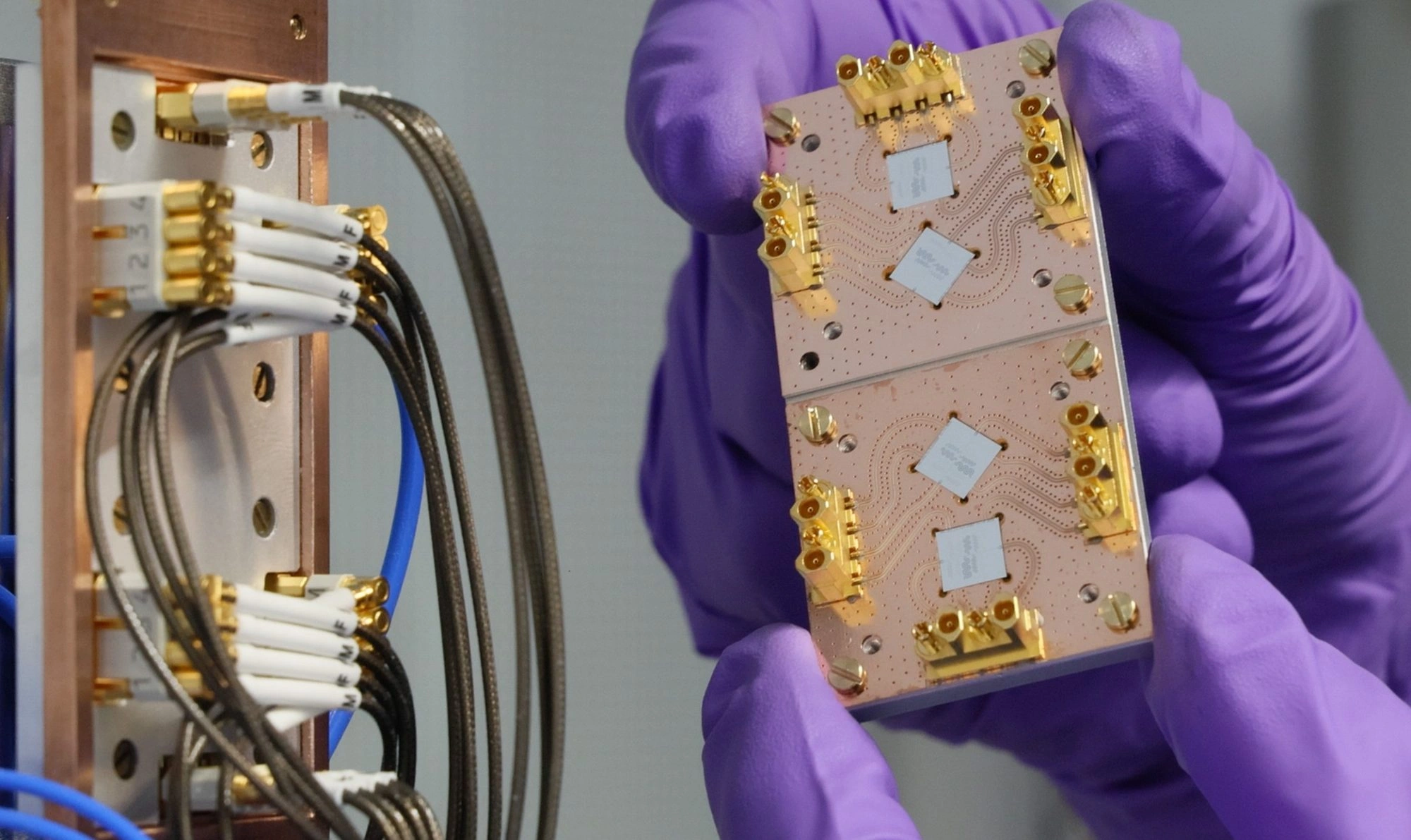
Superconducting chip package and laboratory wiring, Quint Computing official research photograph. A gloved hand is visible; no identifiable person pictured.Develops superconducting quantum processors that aim to prevent errors within the chip itself. Quantum error correction protects fragile quantum information from disturbances; Quint designs the chip, its control electronics and error-decoding software together to reduce the extra hardware needed. Company announced its first €9.1 million funding round on November 3, led by Vsquared Ventures with Quantonation, Nucleus Capital, Faber, Vanagon Ventures, ZOHO.VC and Mikko Möttönen. A separate €2.2 million EIC Pathfinder grant is not equity-round capital.
DTT summary based on Quint Computing's report. The full article is on the publisher's site.
Additional reporting
Company announced its first €9.1 million funding round on November 3, led by Vsquared Ventures with Quantonation, Nucleus Capital, Faber, Vanagon Ventures, ZOHO.VC and Mikko Möttönen. A separate €2.2 million EIC Pathfinder grant is not equity-round capital.
Superconducting circuits operate at extremely low temperatures. Quint aims to suppress a large share of errors in individual circuit elements, then combine the processor with fast control, repeated measurements and real-time error decoding. Error decoding means using measurement signals to identify and correct faults while computation runs.
A 100-fold reduction in hardware overhead, complexity and energy consumption is the stated expectation once the architecture is fully implemented. It is not a demonstrated commercial-system benchmark or a claim that all errors disappear.
The financing supports processor development and first industrial deployment projects. No delivered fault-tolerant commercial computer, qubit count, revenue or named paying customer is inferred.
The founders have investigated industrial applications with Bosch, BASF and Boehringer Ingelheim. Research collaborations are not treated as announced customer sales.
Founded in October 2025 by Christopher Eichler (CEO), Michael Hartmann (CTO) and Jona Stinner. Spinout from Friedrich-Alexander-Universität Erlangen-Nürnberg, part of Munich Quantum Valley.
Expand research and engineering, advance the processor roadmap and pursue initial industrial projects. The company aims for around 40 staff by 2028; this is a hiring target, not present headcount.