Tutor Intelligence raises $75 million Series B for learning warehouse robots
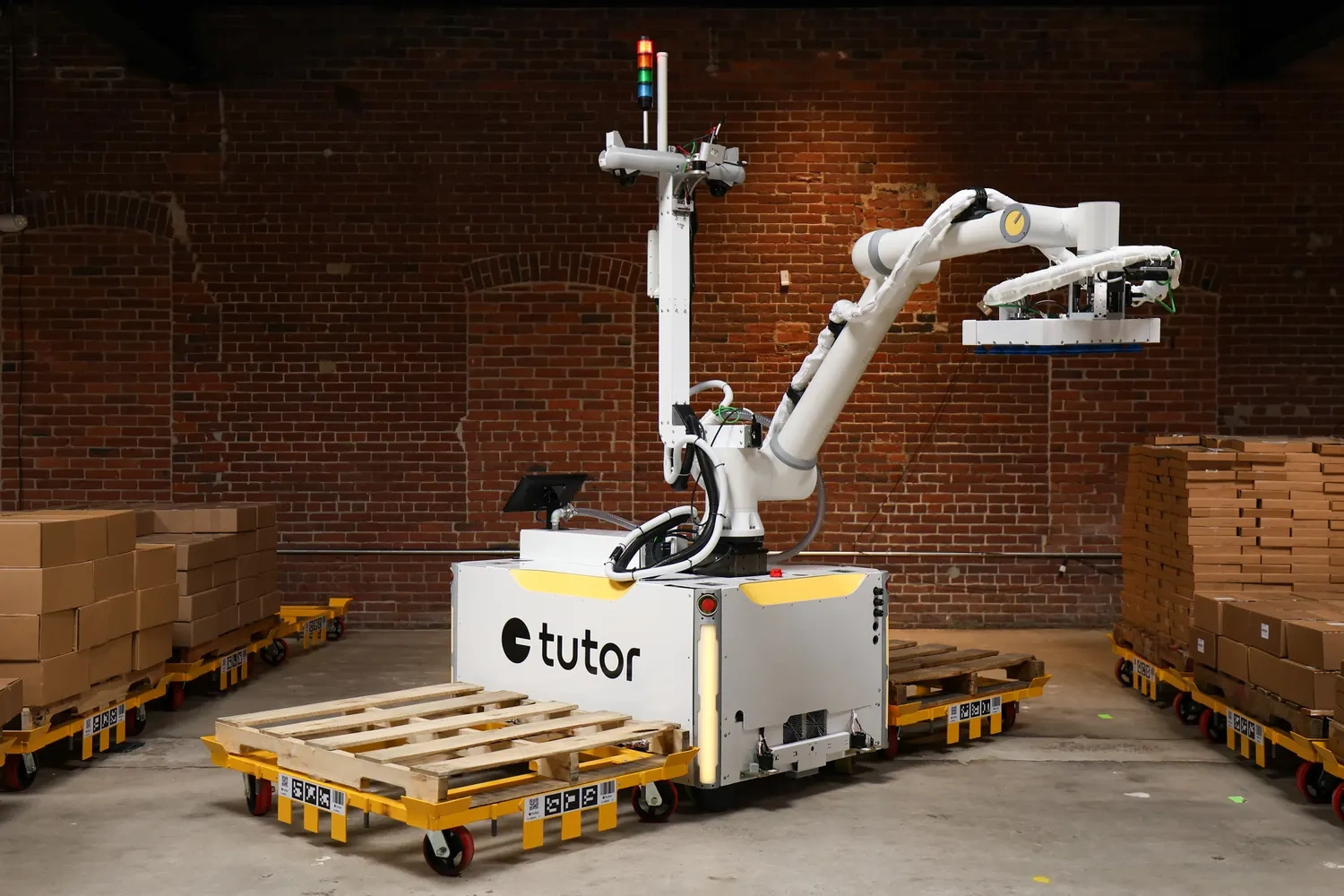
Builds robot hardware and AI models for warehouse and manufacturing work. Its single-arm Cassie handles cases and pallets; two-arm Sonny targets individual-item picking. Remote human operators help perform work and generate training data, so deployment is not the same as full autonomy. Company announced a $75 million Series B on November 2, led by a16z with Union Square Ventures and Neo. Total capital raised: $117 million. Some secondary coverage calls it Series A; the company release and lead investor both explicitly say Series B.
DTT summary based on Tutor Intelligence / Business Wire's report. The full article is on the publisher's site.
Additional reporting
Company announced a $75 million Series B on November 2, led by a16z with Union Square Ventures and Neo. Total capital raised: $117 million. Some secondary coverage calls it Series A; the company release and lead investor both explicitly say Series B.
Cassie has one arm for case picking, palletizing and depalletizing, meaning stacking boxes onto pallets or taking them off. Sonny has two arms for more dexterous individual-item picking, including e-commerce order fulfilment.
Robots work in production environments with input from remote human tutors. The resulting experience data trains shared AI models. A robot foundation model is a model intended to support a range of physical tasks rather than a separate programme for each movement.
Investor a16z explicitly describes deployment ahead of full autonomy. Neither fleet operation nor demonstrations should be interpreted as evidence that every task runs without remote help.
Company says robots operate in almost four times as many facilities as a year earlier and nearly one-third of organisations receiving robots in the past year were repeat customers. These are company-reported metrics, not audited independent measurements; no named customers are inferred.
Company sells work by the hour or by the pick and handles deployment, maintenance and software updates. Its current site also offers outright purchase with a service plan. Product-specific commercial terms are not assumed identical across all customers.
More than 1,000 robots under contract by the end of 2027 is a stated target, not a current installed robot count. Company says the robots will be built in and deployed from the United States.
Train frontier robotics models, manufacture and deploy Sonny and Cassie, and expand the deployment-driven training loop.
Josh Gruenstein, co-founder and CEO, and Alon Kosowsky-Sachs. Based in Watertown, Massachusetts; originated from MIT CSAIL.
$34 million Series A led by Union Square Ventures and co-led by Fundomo, with Neo, brought total funding to $42 million in the company's prior announcement. The latest $75 million round brings the reported total to $117 million; Fundomo is not inferred to have joined this Series B.